Why Is My Emergency Exit Light Flashing? (Gold Coast Strata & Business Guide)
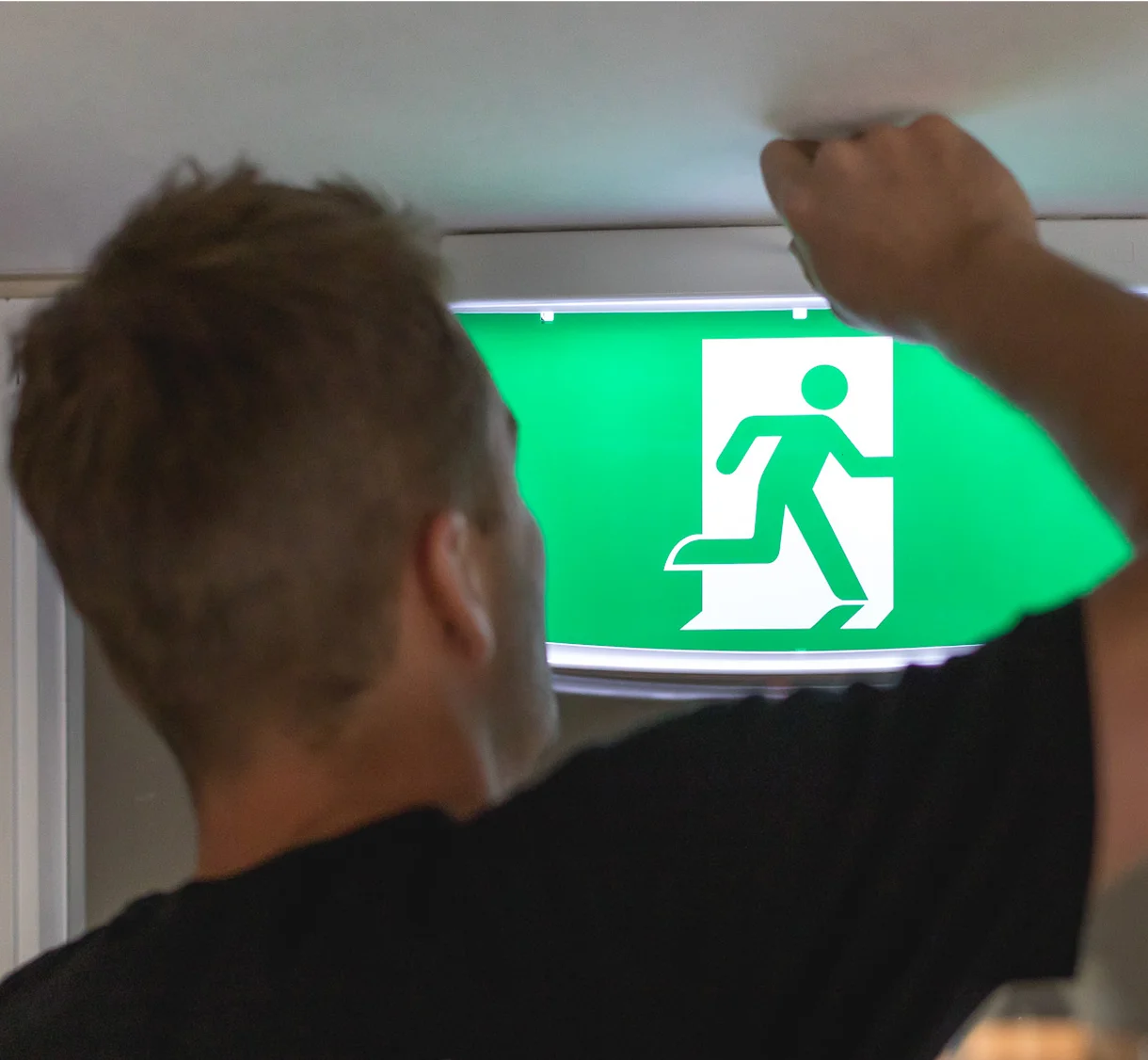
You walk through the foyer of a commercial building — an office block in Robina, a retail strip in Burleigh, an apartment tower on the Coolangatta beachfront — and you notice a green exit sign above the fire stairs. It looks fine. It’s on. But there’s a small red or amber LED on the housing that’s blinking away, once a second, patient and persistent.
That flashing LED is not decoration. It’s the fitting’s way of telling you something is wrong before anyone gets trapped in a smoke-filled stairwell relying on it. Ignoring it isn’t just a maintenance oversight — under Queensland’s building fire safety framework, it’s a compliance problem.
This guide is written for property managers, building owners, body corporate committees, and small business operators on the southern Gold Coast who want the honest answer to a question their contractor may not have properly explained: what does the flashing mean, how urgent is it, and what happens if you don’t act.
The direct answer — what the flashing indicator actually means
Modern emergency exit lights include an internal self-test circuit. The fitting periodically checks its own battery, charger, lamp, and control electronics, and if it detects a problem, it flashes an indicator LED to signal the fault. This is by design. Every reputable Australian emergency lighting brand — Legrand, Clipsal, Stanilite, Mackwell, Famco, and others — uses some version of this self-diagnostic behaviour.
What the flash doesn’t mean is that the light will definitely fail in an emergency. What it does mean is that the fitting has detected a condition that could cause it to fail in one, and the fault is recorded internally until it’s rectified. In compliance terms, that fitting is on borrowed time until someone attends to it.
The specific meaning of the flash varies by manufacturer, and often by flash pattern (slow, fast, single, double, colour). But the underlying causes fall into five categories.
The five things a flashing exit light usually indicates
- Battery fault (most common). The internal backup battery has either failed the most recent discharge test, or its measured capacity has degraded below the level needed to run the light for the required 90 minutes during a mains failure. Emergency light batteries typically last 3–5 years in Gold Coast conditions — sometimes shorter in ceiling voids that get hot.
- Charging circuit fault. The battery is fine but the charger circuit inside the fitting isn’t maintaining it correctly. Could be a component failure on the board, could be voltage variation on the incoming supply. The battery will slowly discharge and eventually fail.
- Lamp or LED failure. On older fluorescent-tube emergency lights, the tube has failed. On LED units, one or more LEDs on the primary emitter has died. The fitting may still glow dimly but the illuminance falls below the AS/NZS 2293 minimum during a real event.
- Self-test failure or communication fault. On addressable and networked systems (common in larger commercial buildings), the fitting has failed to complete its scheduled self-test, or has lost communication with the central controller. The system logs this as a compliance failure regardless of whether the individual light works.
- End-of-life warning. Many modern fittings have a built-in 10-year self-diagnostic that flashes as the unit approaches design life. The fitting still works, but the manufacturer is signalling that end-of-life is close and complete replacement (not just battery) is due.
The only way to be sure which of these applies to your building’s fittings is to reference the fitting’s product manual (the flash pattern is documented) or have a licensed electrician test the unit on-site with a discharge test and diagnostic tool.
How urgent is it?
Not every flashing light is a red-alert emergency, but none of them are “leave it and hope.” Use this rough triage to prioritise:
| Situation | Urgency | What to do |
|---|---|---|
| Single light flashing, next scheduled 6-monthly test is within 2 weeks | Log and address at scheduled test | Record the fitting location and the observed fault. Have your compliance contractor address at the next scheduled service. |
| Single light flashing, next scheduled test is more than 2 weeks away | Address before next test | Book an interim service visit. Faulty fitting is on the compliance record until rectified. |
| Multiple lights flashing across the building | Urgent | Book an emergency service call. Systemic fault likely — could be a shared charger, mains issue, or overdue whole-system replacement. |
| Flashing following a storm, power surge, or building works | Urgent | Post-event fault. Full system test recommended to confirm no wider damage. Storm season on the Gold Coast makes this common between November and April. |
| Flashing plus obvious physical damage — cracked housing, water staining, discolouration | Immediate | Isolate the fitting from a safety standpoint, tag as out of service, replace as soon as possible. Damaged emergency luminaires can create electrical hazards. |
The key principle: an isolated single-fitting fault caught at scheduled service is normal maintenance. Multiple faults, systemic patterns, or post-event flashing points to a bigger problem that needs proper investigation.
What the standards actually require
Emergency and exit lighting in Australian commercial buildings is governed by the AS/NZS 2293 series — a three-part standard referenced by the National Construction Code, which makes it a legal requirement rather than a recommendation.
| Standard | What it covers | Relevance |
|---|---|---|
| AS/NZS 2293.1:2018 (Amendment 1, 2021) | System design, installation, and operation | Governs where lights must be installed, mounting heights (typically 2.0–2.7 m for exit signs), and illuminance requirements along escape routes. |
| AS/NZS 2293.2:2019 | Routine service and maintenance | The compliance backbone. Mandates 6-monthly 90-minute discharge tests, annual inspections, and record-keeping obligations. |
| AS/NZS 2293.3:2018 | Emergency luminaires and exit signs specifications | Governs product-level performance — running-man symbol, colour, maximum viewing distance printed on the sign face (commonly 24 m or 40 m). |
In Queensland, the occupier of a commercial building is responsible for ongoing compliance under the Building Fire Safety Regulation 2008, which incorporates AS/NZS 2293 through the NCC. Enforcement sits with Queensland Fire and Emergency Services. The obligations apply whether the building is a commercial office, a retail shop, a hospitality venue, a strata apartment complex, or an industrial site.
The 6-monthly test cycle — what actually happens
The core compliance requirement in AS/NZS 2293.2 is a full 90-minute discharge test performed every 6 months by a competent person, with the results recorded in a logbook (paper or digital) that must be retained. Here’s what that test involves in practice:
- The electrician isolates the mains power to the emergency lighting circuits — without shutting down other building electrical systems.
- A timer starts. Every emergency light and exit sign in the building must operate on internal battery for the full 90 minutes.
- The electrician walks the building at intervals during the discharge, checking every fitting is illuminated and reading properly.
- At the end of 90 minutes, any fitting that has flickered off, dimmed below spec, or failed to illuminate is recorded as failed. Its battery, lamp, or the whole fitting is replaced.
- The mains supply is restored, chargers begin re-energising the batteries, and the electrician documents the test results in the building’s fire safety logbook.
- Between tests, faults reported by the self-diagnostic indicators (the flashing lights) are attended to as they arise. A fitting flashing today shouldn’t wait for the scheduled test six months away — it should be addressed before then.
The 90 minutes matters because in a real fire, Queensland Fire and Emergency Services needs time to arrive, assess, search the building, and establish command. Emergency lighting needs to work for the full evacuation window — not just the first ten minutes.
What happens if you ignore it
Emergency and exit lighting failure is one of the most common reasons a commercial building fails a compliance inspection in Queensland. The consequences of a flashing indicator ignored are worse than most owners realise:
Consequences of unaddressed emergency lighting faults
- Compliance failure on your fire safety records — flagged at inspection or audit
- Enforcement action under the Queensland Building Fire Safety Regulation 2008, which can include improvement notices, prohibition notices, and penalties
- Insurance claim jeopardy — commercial building insurers routinely require documented AS/NZS 2293 compliance as a condition of coverage; an incident on non-compliant equipment can void the claim
- Personal liability for the occupier, building owner, or body corporate committee members if occupants are harmed during an evacuation
- Occupant safety risk — the real one. If a fitting fails during a genuine evacuation and someone is injured, everything else is a footnote
None of this requires a fire to occur. A routine compliance inspection, an insurance audit, or a QFES-issued fire safety notice can each surface non-compliance and trigger enforcement.
Whose responsibility is it? — Strata and body corporate answers
This is one of the most frequent points of confusion, particularly in mixed-use and residential strata buildings on the Gold Coast. In broad terms:
- Commercial and industrial buildings: The occupier (typically the tenant) or the owner (where the building is owner-occupied) carries the primary compliance obligation under the Building Fire Safety Regulation 2008.
- Strata and body corporate residential buildings: Emergency and exit lighting in common property areas (lobbies, foyers, corridors, fire stairs, carparks) is the body corporate’s responsibility. Lighting inside individual lots is generally the lot owner’s responsibility, but the interface can vary — check your community management statement.
- Retail and hospitality tenancies: The lease determines the split. Landlord typically responsible for base building compliance, tenant responsible for fit-out. A flashing exit light in a shop’s own back-of-house area is usually the tenant’s job; one in the shared arcade corridor outside is the landlord’s or the arcade management’s.
- Mixed-use developments: A shared services engineer or facilities manager typically coordinates compliance across the whole building on behalf of the various responsible parties.
When responsibility is unclear, the practical answer is: whoever gets the fire safety inspection findings is the one enforcement will chase. Sort responsibility out in advance rather than after the notice arrives.
DIY vs licensed — what’s actually allowed
Emergency and exit lighting is fixed electrical equipment. Testing, servicing, and repair must be carried out by a licensed electrical contractor under the Electrical Safety Act 2002 (QLD). Building occupiers and property managers are legally allowed to:
- Visually inspect fittings for damage, flashing indicators, or missing signage
- Record observed faults in the building fire safety logbook
- Log a service call with a licensed contractor
- Verify that scheduled 6-monthly tests are being carried out
You are not allowed to open a fitting, replace a battery, replace a lamp, adjust wiring, or perform the mandated discharge test yourself. Doing so is illegal, voids the building’s insurance position, and creates a real safety risk.
What a proper compliance service looks like on the southern Gold Coast
Every emergency and exit lighting service we carry out for commercial and strata clients across Palm Beach, Burleigh Heads, Robina, Broadbeach, and the wider southern Gold Coast follows the same structured process:
- Initial audit — walk the building, catalogue every fitting, note age, brand, condition, and any observed self-diagnostic faults
- Full 90-minute discharge test — as required by AS/NZS 2293.2, all fittings tested to their full rated duration
- Illuminance verification — light meter readings on escape routes to confirm AS/NZS 2293.1 illuminance requirements are met
- Sign visibility check — running-man symbols correct, mounting height 2.0–2.7 m, viewing distance ratings suitable for the space
- Fault rectification — battery replacements, lamp/LED replacements, or whole-fitting replacements as required, all fixed-price quoted before work starts
- Logbook update — test results, faults found, actions taken, all recorded and retained per compliance obligations
- Preventative maintenance plan — where clients want it, a fixed-price ongoing programme so compliance is scheduled, budgeted, and not left to memory
The point isn’t to sell a service — it’s that a proper compliance test isn’t something a building can skip, and a competent one costs less than the enforcement risk of doing it badly.
Frequently asked questions
Can I just replace the battery myself to stop the flashing?
No. Emergency and exit lighting is fixed electrical equipment and testing, servicing, and repair must be carried out by a licensed electrical contractor under Queensland’s Electrical Safety Act 2002. Doing it yourself is illegal, voids your compliance position, and doesn’t count toward your logbook — meaning you’d still fail an inspection.
How often should emergency exit lights actually be tested?
Every 6 months, by a competent person, with a full 90-minute discharge test — that’s the requirement in AS/NZS 2293.2. Records must be kept in a logbook (paper or digital) and retained for audit purposes.
How long do emergency light batteries last on the Gold Coast?
Typically 3–5 years, sometimes shorter in ceiling voids and roof spaces where sustained heat accelerates battery degradation. Coastal humidity and salt air also shorten service life. Batteries that pass the 6-monthly discharge test today can fail the next one — which is why the testing cycle exists.
What’s the difference between an exit sign and an emergency light?
Exit signs are the green running-man signs pointing to escape routes. Emergency lights are separate fittings that illuminate the escape route itself when mains power fails, so occupants can see where they’re walking. AS/NZS 2293 governs both — they have separate but related requirements.
My building has photoluminescent (glow-in-the-dark) exit signs. Are they compliant?
AS/NZS 2293 allows photoluminescent signs only in very specific circumstances — they must be continuously charged by a specified level of ambient lighting. In practice, that limits them to spaces where the general lighting is on 24/7 at sufficient level. In most Australian commercial and strata buildings, they’re not a reliable compliance option and can create a false sense of security. If you have them, get an assessment.
How much does emergency exit light testing cost on the Gold Coast?
Fixed-price per building based on the number of fittings, building layout, and whether any faults need rectifying at the time of the test. We quote on site before the test begins so the number is known upfront. Preventative maintenance programmes with a set annual price are also available for clients who want compliance scheduled and budgeted rather than reactive.
Who is legally responsible in a strata building?
Emergency and exit lighting in common property areas (foyers, corridors, fire stairs, carparks) is the body corporate’s responsibility. Lighting inside individual lots is generally the lot owner’s responsibility. Your community management statement sets the boundary — check it if in doubt.
Need a full emergency lighting service on your commercial or strata property? Call us — fixed-price test and repair, logbook updated, compliance sorted.